
Trace Switzerland County Former Owners Transfer by Transfer
A prior-owner chain reads as a timeline built upward. Each row must capture one land-matched transfer. A person who merely shares the right surname proves nothing, so work from the newest deed into older indexes and log every conveyance that touches the same land.
| Transfer date | Grantor to grantee | Deed type | Book or land reference |
|---|---|---|---|
| Newest recorded date | Immediate former owner to current grantee | Type exactly as indexed | Public ID or book/page plus legal description |
| Earlier recorded date | Next prior owner to that former grantee | Warranty, quitclaim, corrective, or other deed | Matching lot, tract, and prior instrument |
| Estate or partition date | Estate, heirs, or court-directed party to successor | Representative or commissioner's deed if shown | Deed and case references kept together |
| Historic book entry | Earlier grantor to grantee | Deed-book wording | Book/page and original land description |
Dates alone prove nothing about continuity. The legal description, referenced plat, prior instrument, and parcel context must hold each transfer to the same tract of land.
Go Back Through the Switzerland County Deed Chain
Begin from a parcel you know. Treat the newest matching deed only as the doorway, then walk backward one owner at a time through the Switzerland County deed chain.
- Copy the assessment owner and legal-description clues from WTHGIS.
- Find that party as grantee in the Doxpop recorder index, match the land, and note the grantor.
- Search that grantor as a grantee in an earlier period and match the next acquiring deed.
- Repeat through name variants, related parties, corrections, and estate branches until the online window ends.
- Continue the direct and indirect index method in deed books or microfilm.
Search every name when a deed lists several parties. Never stop at the first address match. An older deed may instead identify the land by lot, survey, acreage, adjoining owner, road, or watercourse. The recorded-document search screen is the modern doorway into that backward walk:
Use its party-name and date filters first. The deed's own land description then decides whether the instrument belongs in the chain.
Bridge Switzerland County Previous Owners Across 1999 and 2003
Two dates explain most of the confusion online. Doxpop reports index coverage starting in January 1999, while scanned images begin in February 2003. That gap cuts both ways. An index hit can exist with no image attached. A pre-1999 conveyance can be perfectly valid even when the modern search returns nothing. Review the published county coverage and save both cutoffs. For an indexed deed without an image, request the instrument by its public ID. Book and page works too. For earlier former owners of Switzerland County land, move on to courthouse sources. The State Library is the other option. The Recorder's county page connects the online index with the office. That office keeps the official instrument:
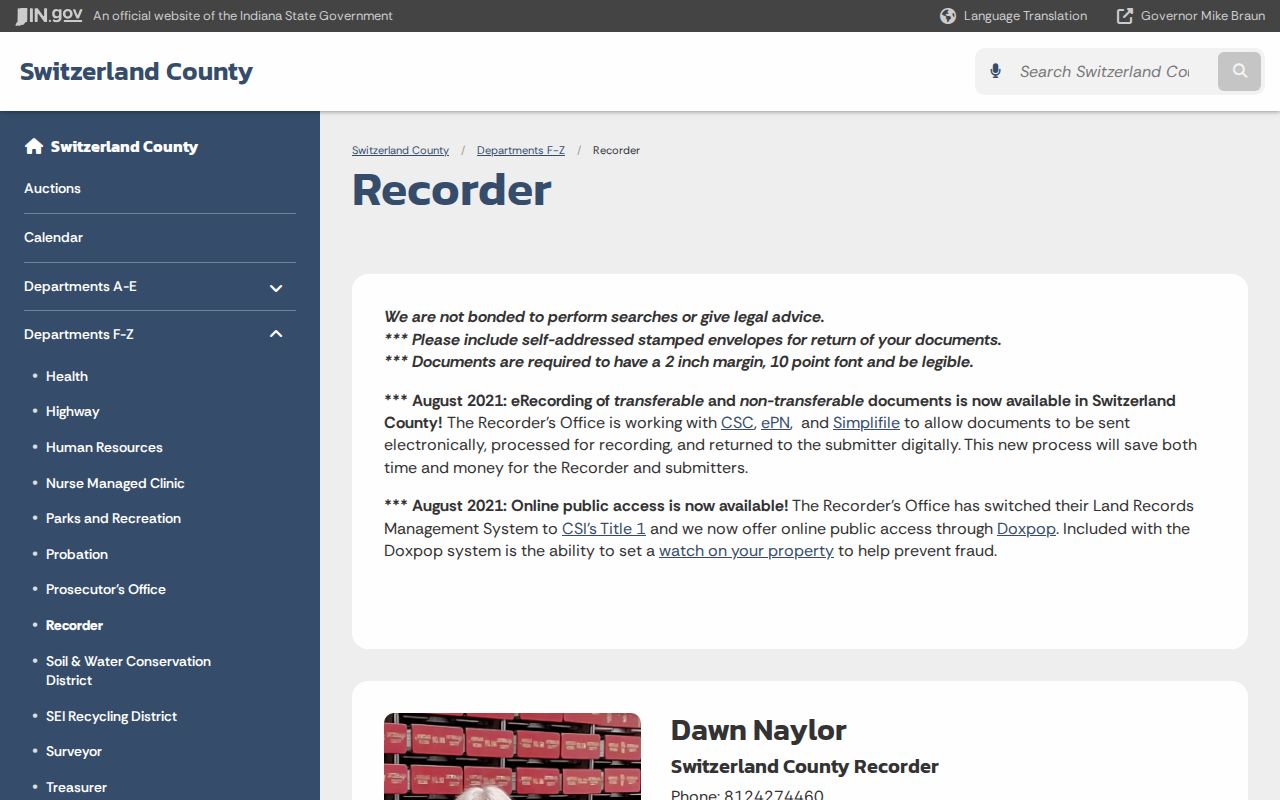
That handoff matters most when a historic index hit has no viewable deed. It is also the route to a certified copy.
Online cutoff. The index starts in January 1999 and images in February 2003. Older owners require deed books, microfilm, or an office request.
Browse the Switzerland County Historical Index by Book
A book-first route helps when a name search fails. The historical-index interface works from the volume instead of the surname. Choose Recorded Document. Open View Historical Indexes and select deed or mortgage. Pick the year range or book label, browse the relevant letter, save the book and page, and enter it for retrieval when an image is offered.
This route rescues a prior owner hidden by odd spelling or punctuation. It still yields an index or an image, never a certified title conclusion.
Note: Browse related surname forms, but accept a match only after the land description or book reference agrees.
Reconstruct Prior Switzerland County Owners on Microfilm
The State Library microfilm inventory reaches back to 1814. It lists deed indexes from 1814 to 1900. It also lists deeds from 1815 to 1886, and separate indexes from 1817 to 1900. Keep the overlaps exactly as the catalog gives them. These are retrieval leads, not a promise that every volume survives complete or legible. All microfilm sits on the second floor. Request the series and reel, then determine whether its index runs by grantor, grantee, direct, indirect, or combined entry. Ask the Recorder about courthouse books covering any gap between the historic run and the online index.
- Grantor
- The party conveying an interest.
- Grantee
- The receiving party searched backward in an earlier index.
- Reverse index
- The grantee or indirect side used to locate an owner's acquisition.
- Chain of title
- Land-matched transfers, not a collection of similar names.
- Quitclaim and warranty
- Different forms whose text and land description must be read.
Match Switzerland County Former Owners to Historic Maps
Old maps explain what an address cannot. They never replace a conveyance. An 1838 Vevay plan anchors the State Library map inventory. The same inventory holds an 1883 atlas, a 1912 owner map, later plat books, and a 2022 plat book. Compare each map's owner label against deeds and plats from the same period. Match the road, farm, lot, or tract as well. A dated map can expose a renamed road. It can also reveal a parcel split. It may show an old lot number or the origin of a subdivision. Use the second-floor reference desk. The State Library asks for the call number, title, and size.
Use Tax Duplicates When a Switzerland County Name Disappears
Names sometimes vanish between deed volumes. A 1991 Indiana Heritage Research Grant documented the recovery and classification of mixed Treasurer and Auditor materials. The recovery occurred during courthouse renovation. Its abstract describes nearly complete tax duplicates. The abstract calls them useful for names and assessments. A duplicate can bridge a gap, though it cannot prove a conveyance. Ask the Auditor or State Library for the series and years. Also ask for the box or reel and access location. A duplicate may place a prior owner against an assessment or confirm a spelling variant. Probate and court records can explain an estate, partition, or court-directed transfer. Keep the case reference beside the later deed.
Request an Earlier Switzerland County Ownership Instrument
The Switzerland County Recorder holds the permanent instruments. The office sits at 212 W Main Street, Vevay. Staff there do not conduct searches. Supply a book and page, public ID, names, date, and land description, and say whether an ordinary or certified copy is needed. Published charges are $1 for letter, legal, or ledger copies, $5 for survey sizes, and $5 for certification. Confirm payment instructions at 812-427-4460 before mailing. The county page carries conflicting check directions, and for single-instrument mechanics the Switzerland County deed records guide spells out the details.
Know Where the Switzerland County Former-Owner Trail Ends
Switzerland County opened its land story early, with the county itself established in 1814. Federal patents from that era often trace back through the Jeffersonville Land Office. A patent names the original federal grantee, though. That is not the first private deed. It is a different record from the first deed recorded at the county level. Keep those two trails separate when you build a chain of title.
Historical digging pays off for house histories, heir questions, and purchase diligence alike. Still, a matching surname proves nothing. When the work turns on a title opinion, estate distribution, a boundary survey, lien priority, or a missing instrument, hand it to a qualified professional.
Lawful historical use. Reconstruct previous owners through land-matched records. Do not use the trail to track, harass, intimidate, or harm a person.