
Read Switzerland County Property Tax Records by Source
Switzerland County property tax records live in separate ledgers, not one file. The Assessor sets the value. The Auditor keeps the tax duplicate and transfer plats. The Treasurer posts bills, payments, and delinquency. WTHGIS stitches several views together, yet each field answers a different question, so save the parcel number, assessment year, tax year, and installment before comparing anything across systems.
| Field | What It Shows | Where |
|---|---|---|
| Land, improvement, and total assessed value | The assessment components for a stated year | Assessor card and DLGF search |
| Tax duplicate | Value, taxes, ownership, rates, and deductions | Switzerland County Auditor |
| Installment and status | Amount due, payment date, and delinquency | Treasurer, WTHGIS, or SRI |
| Tax district | The administrative district used for the levy | Parcel card and tax record |
| Sale notice | Parcel, roll owner, amount, legal description, and sale terms | Auditor and Treasurer notice |
A tax bill is not a deed. Its balance is not a sale price either. Indiana assessment targets market value-in-use, while the bill applies the taxing process to the assessed record. A recorded sale may be atypical or fall in a different assessment cycle. For value questions rather than bill questions, see the Switzerland County property value guide.
Build the working file from more than one custodian. Record the Assessor's value row, the Auditor's duplicate or transfer entry, and the Treasurer's payment posting side by side. Names can differ. Compare dates before calling it an error. A deed may record before the assessment roll changes, and the tax duplicate can preserve the owner tied to its own cycle, so a mismatch is often timing rather than a mistake.
Switzerland County Property Tax Access Has Three Online Doors
The Treasurer links WTHGIS for property information, tax amounts, and payment history, plus SRI for property and tax reports. PayGov handles online payments. The three services overlap, but none replaces the others. A payment screen does not prove funds posted to the right parcel, and an assessment card shows nothing about title.
| Online source | Best use | Record to save |
|---|---|---|
| Switzerland WTHGIS | Parcel, values, tax amounts, due dates, and payment history | Punctuated parcel ID, year, status, access date |
| SRI Properties | County-linked property and tax report | Parcel, tax year, report date |
| PayGov | Online payment channel | Confirmation plus later Treasurer posting |
| DLGF assessed-value search | Assessment details and downloads | Assessment year and value components |
The official Treasurer page is the control point for current payment instructions. It names the county-approved lookup and payment routes.
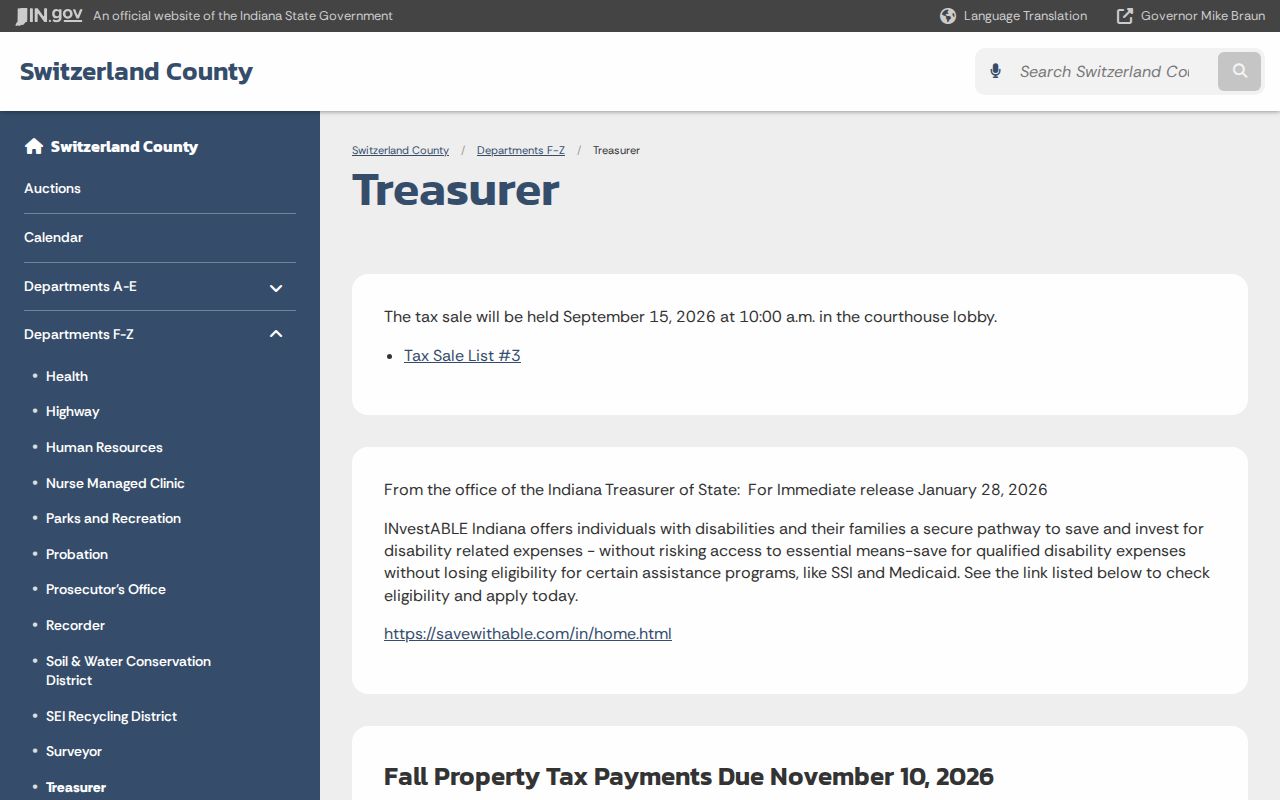
A screen only locates the system. Save the receipt. Confirm the posting before you rely on it.
If the vendor application will not render, call the Treasurer with the full parcel number and tax year. An office visit works too. For assessment detail, contact Assessor Stacey Mathews at 812-427-4410 or assessor@switzerland.in.gov. For the duplicate, deductions, ownership plats, or transfers, contact Auditor Gayle Sullivan at 812-427-4470 or auditor@switzerland.in.gov.
Trace a Switzerland County Property Tax Bill
Start with the situs address or parcel number. Keep every dash, period, and leading zero. County sale notices show identifiers beginning with 78. The county has not published a meaning for every segment, so treat the number as a key rather than a code to decode.
- Open WTHGIS and find the parcel by exact address or parcel number.
- Record the tax year, installment, due amount, paid or delinquent status, and each payment date.
- Compare the Assessor or DLGF value detail and note its assessment year and as-of date.
- If delinquency appears, check the official sale notice and ask the Treasurer or Auditor about payment, judgment, sale, and redemption status.
Keep assessment year and tax year in separate columns. A live parcel card can label work-in-progress values as uncertified. Never swap a final bill for a newer draft.
An address search sometimes returns several candidates. Match the legal description, township, district, and parcel number before choosing. A mailing address may differ from the property address. Indiana confidentiality rules can also substitute a protected mailing address. Work with the public land fields that remain visible. Do not fill a hidden address from an unrelated source.
- Assessed value
- The value assigned through Indiana's assessment process for the stated year.
- Levy and rate
- The public revenue amount and rate applied through the taxing process.
- Deduction or exemption
- A qualifying adjustment administered through the county assessment and tax system.
- Tax lien
- A legal claim tied to unpaid tax, which requires current official confirmation.
Current Switzerland County Property Tax Payment Channels
The Treasurer's current instructions list several ways to pay. Mail the payment with the full first page or coupon. The courthouse drop box sits on the Main Street side. Friendship State Bank accepts on-time payments with the bill or coupon. The courthouse counter takes cash, check, or card. Card payments carry a 2.35% fee, the postmark controls a mailed payment, and fall taxes are due November 10, 2026.
These details change. Check the Treasurer page before sending funds, include the parcel and installment reference, and keep proof. For in-person questions, the Treasurer lists Monday through Friday hours of 8:00 a.m. to 4:30 p.m. and telephone 812-427-4390.
Remember the limits of each route. The bank is for on-time payments only. The drop box and counter are separate channels. Anyone reviewing another person's public tax status should record only what the official account shows and should not assume why an installment was late.
Note: A processor confirmation should be matched to the later county payment history before the tax item is treated as posted.
Switzerland County's .93-to-.96 Assessment Multiplier
Switzerland County's assessed values now reflect a location multiplier of .96, up from .93, alongside changes in statewide cost tables. The move belongs to mass appraisal. No single parcel automatically gained the same three-point bump. Before submitting anything to the Department of Local Government Finance, the Switzerland County Assessor weighs age, condition, grade, neighborhood base rates, and recent sales for each property record.
Indiana adjusts assessments every year. Its ratio studies compare assessed value with sale price to test accuracy and uniformity across the tax roll. The statutory target is 100% of market value-in-use. That standard never sets the next assessment. Related-party, distressed, partial-interest, and personal-property-inclusive sales may behave unlike ordinary market evidence in an appraisal file.
For ratio studies, approval letters, narratives, and land orders, the DLGF Switzerland County page is the stronger source. Check the year on each document. A countywide study explains method and broad adjustments, yet a parcel appeal still turns on that parcel's own characteristics, classification, and evidence.
What Switzerland County Tax Sale Records Establish
The Switzerland County Treasurer has scheduled a tax sale for September 15, 2026, at 10:00 a.m. in the courthouse lobby. The 2025 Second Advertisement shows the record fields. Expect a parcel number, delinquent amount, and roll owner. Legal description, address, judgment timing, minimum-bid costs, auction terms, and redemption details round out the entry. Keep the years straight. The 2025 advertisement and 2026 sale differ.
A parcel on the list has entered a public delinquency process, not necessarily passed to a bidder with clear title. Outcomes shift. Payment after publication, judgment status, auction results, statutory redemption, later notices, liens, and deed issuance can all change the picture. Verify the present status with the Treasurer and the Auditor. When legal reliance matters, compare the latest deed record and any court file too.
The minimum bid may combine delinquent and current taxes, penalties, publication costs, postage, sale costs, and prior unpaid amounts. That sum is not value. The notice is unusually useful because it joins an owner name, parcel ID, situs, and legal description in one place, which makes cross-checking WTHGIS and the Recorder easy. Use it as a bridge, not a shortcut.
Tax sale is not instant title. A bid or notice does not erase redemption rules, lien questions, or the need for a title review.
Request a Switzerland County Tax Duplicate Offline
When an online property record is missing, unclear, or tied to an old year, request a tax duplicate from the Switzerland County Auditor. That office keeps value and tax information. It also holds ownership and assessed-value plats, transfers, deductions, rates, and tax-sale administration. A precise request gets better results. Include the parcel number, situs, and owner name. State the exact year range and whether you want inspection or a copy.
Indiana's Access to Public Records Act, IC 5-14-3, covers existing records. It calls for a response within a reasonable time. Inspection is generally free. Authorized copy charges may still apply. The office need not build a custom report or decide title, so keep your own paper trail: request date, response, fee, record identifier, and any cited denial ground.
For remote work, ask whether the record can be emailed, mailed, or read at an office terminal. Confirm payment method and prepayment rules first. A request for all records stalls, while a parcel, year range, record type, and copy format moves.
Do Not Turn a Switzerland County Tax District Into a City
Switzerland County contains six townships: Cotton, Craig, Jefferson, Pleasant, Posey, and York. Its incorporated towns are Vevay and Patriot. A township, a taxing district, a municipal boundary, a situs address, and a ZIP label are five fields. Each is different. One label never settles the others.
The split matters because rates, zoning, and notices all turn on jurisdiction. Preserve each label exactly as the county record shows it. A Vevay or Patriot mailing address may still require a parcel-level municipal boundary check. Never rewrite a township name as the town. When a GIS map and the tax record appear to conflict, ask the Auditor or Assessor which district governs. Ask which assessment year governs too.
ZIP geography adds one more label. It still does not fix the district. A property can carry a familiar mailing place while sitting outside any incorporated boundary. Trust the district on the county record. For a current tax bill, verify it against the relevant assessment year. Do not rely on an old map's city line.
Contest a Switzerland County Property Tax Assessment
A dispute over an assessment belongs with the Assessor, not the Treasurer's payment portal. Start there. The Assessor page lists June 15, 2026 as the 2026 filing deadline. It points taxpayers to current DLGF forms. Form 130 opens the taxpayer's appeal. The assessment notice plus current instructions identify the relevant year and the next steps through the Property Tax Assessment Board of Appeals.
Strong evidence is parcel-specific. Gather the notice, the property card, land and improvement values, and correct characteristics. Recent sales evidence and photographs help too. A factual error in area, grade, condition, or classification can carry real weight. Treat the local multiplier change as context rather than proof that one parcel is wrong. Pull the current form and version from the DLGF forms catalog.
Keep two documents distinct in your mind. Form 11 is an assessment notice. Form 130 starts an appeal. File with the stated office by the date in the current notice or instructions. Hold onto proof of delivery. Remember that the Treasurer cannot change an assessment. The tax bill simply came in higher than expected.
The Indiana catalog page displays where the state publishes Form 130. Its related assessment forms appear there too.
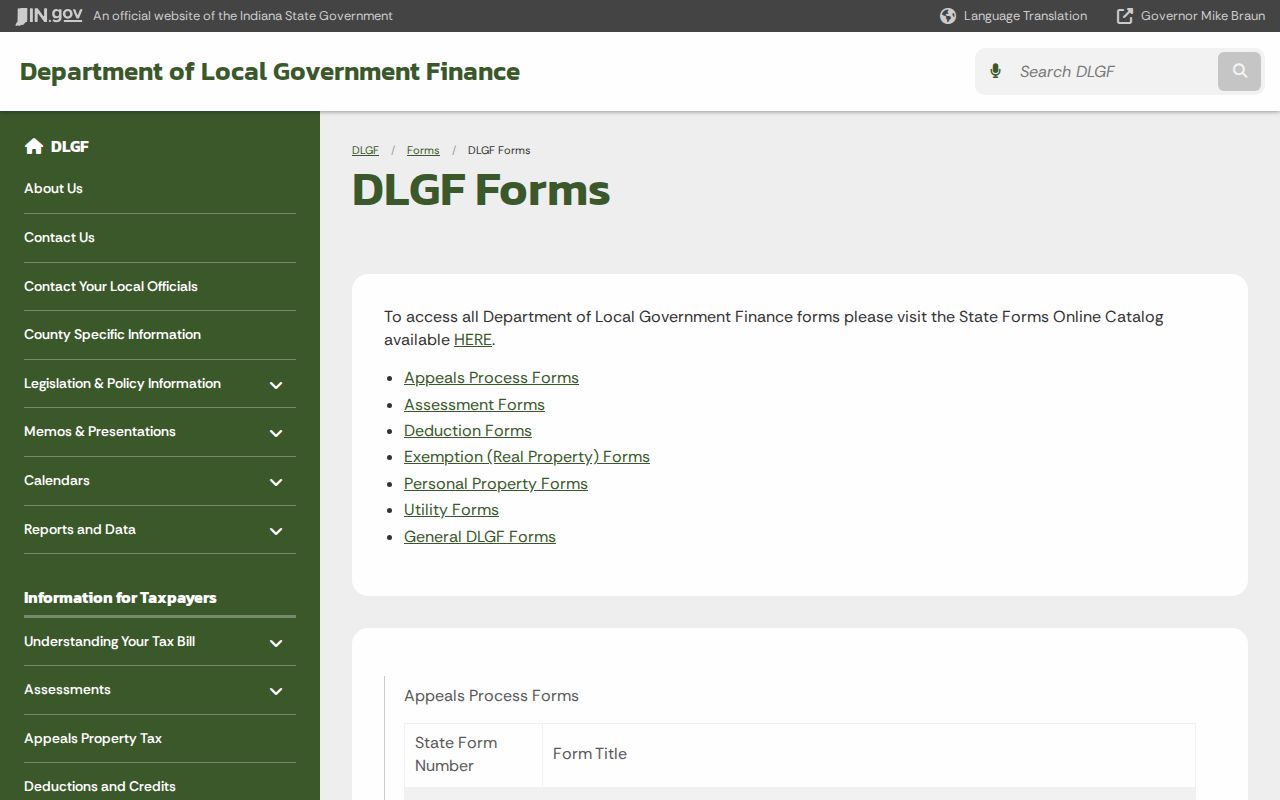
Check the deadline printed on your notice for the exact assessment year. The 2026 date should not carry over into a later cycle.
Appeal window. The Assessor listed June 15 for 2026 forms. Read the current notice and DLGF instructions before filing for another year.