
Compare Switzerland County Property Value Types
A parcel carries several values. In Switzerland County, the assessment record splits land and improvement components for a stated year. A transfer row can preserve a sale amount. Indiana's tax system adds market value-in-use. Before comparing any of them, keep the label, year, source, and as-of date attached to each figure.
| Value | What It Is | Where |
|---|---|---|
| Assessed value | Mass-appraisal value assigned for the assessment year | Assessor card and DLGF detail |
| Market value-in-use | Indiana's value standard based on a property's use | Assessment framework and ratio studies |
| Last sale or consideration | Amount connected with a transfer, which may not be a standard market sale | Deed and parcel transfer history |
| Land and improvement components | Separate parts used to build the total | Property record card |
Indiana's assessment target is 100% of market value-in-use. That goal does not make an assessed value identical to a recent sale. Timing, use, parcel characteristics, annual adjustment, and whether a transfer was arm's-length all shape the gap. An assessment is not a private appraisal either. Tax liability is a separate number. It belongs on the tax account. A deduction can change taxable treatment without moving the underlying assessment the same way. Value fields are not billing fields. Keep them apart from rate, installment, payment, and delinquency entries.
How Switzerland County Builds Assessed Value
The Switzerland County Assessor works through mass appraisal. The office reviews properties across an area, weighing age, condition, grade, neighborhood base market rates, property characteristics, and recent sales. It then submits a ratio study to the Department of Local Government Finance. The method values a whole class of property with consistent data rather than producing a private appraisal parcel by parcel.
Indiana requires annual adjustments. Values can move without a sale. Updated cost tables, land orders, corrected characteristics, neighborhood evidence, omitted property, and ratio-study work can all shift the recorded amount. Read the current row beside prior years. The newest total is not an isolated fact.
The Assessor sets assessed value and nothing else on the bill. Tax rates and bills come from other offices. The Auditor maintains the tax duplicate, transfer, deduction, and ownership-plat work. The Treasurer handles billing and posting. A higher value and a higher bill can be related, yet they remain different records with different custodians.
Look Up a Switzerland County Property Value
Start with the exact address or full parcel number. WTHGIS can locate the property card. DLGF publishes a statewide assessed-value search with Details and Download controls. Save the original parcel string and assessment year so punctuation changes or later parcel splits do not break the comparison.
- Find the parcel in WTHGIS by situs address or parcel number and open its card.
- Record the land, improvement, and total figures with assessment year and as-of date.
- Check DLGF's assessed-value detail and note whether the displayed row is current, prior, or still in progress.
- Read the deed or transfer entry for sale context, then test whether it was a standard market transaction before comparing prices.
The Indiana assessed-value search is the state entry point pictured below.
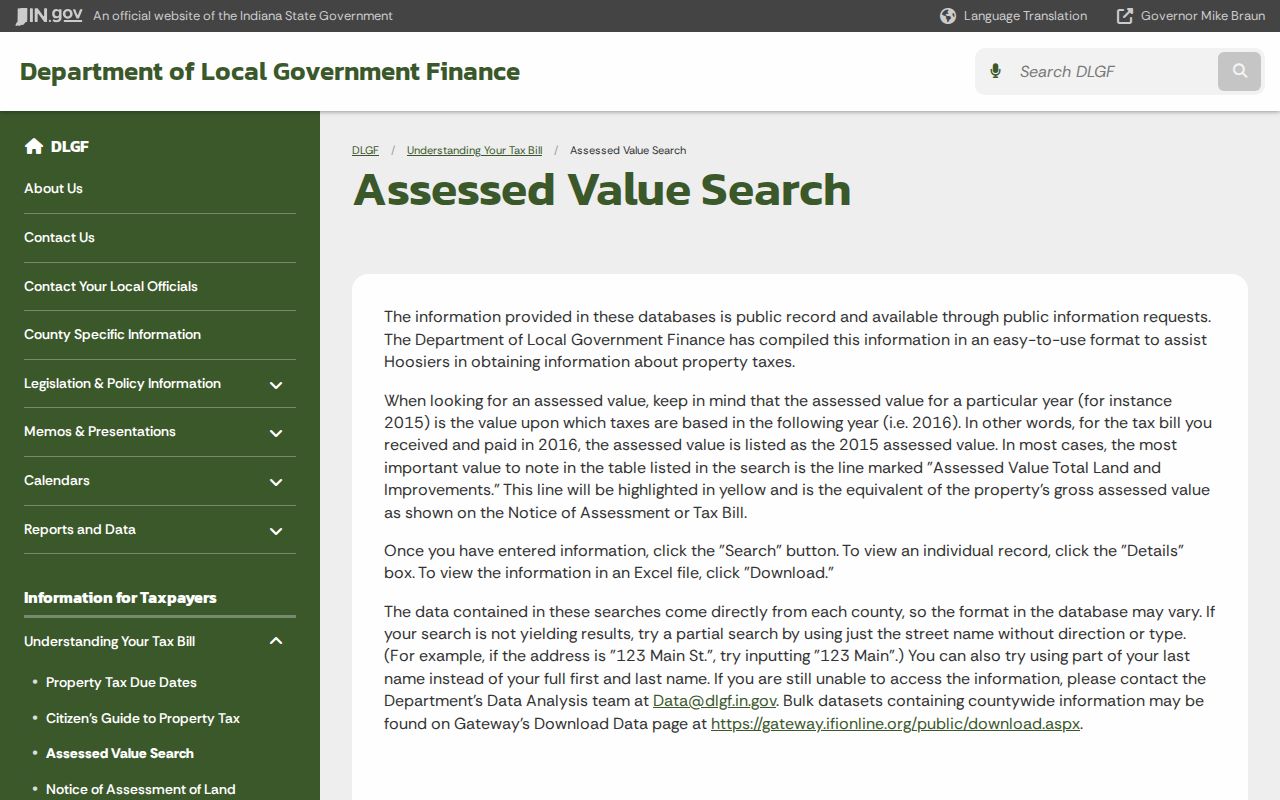
That screen opens assessment data and downloads. It does not replace a dated property card, a recorded deed, or an appraisal.
An address search can fail. Try the full parcel ID, a partial street without direction or type, or the owner name as a locator. Confirm situs, mailing address, legal description, and district. Similar names and rural mailing places return the wrong parcel when the legal fields are skipped.
- Assessed value
- The value placed on the assessment roll for a specified year.
- Market value-in-use
- Indiana's standard tied to the property's use, not a guaranteed sale price.
- Assessment ratio
- Assessed value divided by sale price in DLGF ratio analysis.
- Sale or consideration price
- The amount reported with a transfer, subject to transaction context.
- Reassessment or annual adjustment
- The process that refreshes recorded value and property data over time.
Indiana's Ratio Standard for Switzerland County Values
DLGF publishes annual ratio-study material for Switzerland County. The package includes approval letters, narratives, and land orders. The ratio formula compares assessed value with sale price. The state standard is 100% of market value-in-use, and the studies test broad accuracy and uniformity across assessment work rather than promising that one property's assessment will equal its last recorded price.
Match the assessment year to the sale period. Check whether the sale was even accepted for the study. A family transfer, partial-interest deed, foreclosure-related transaction, or personal-property-inclusive deal can be poor evidence of open-market value.
A ratio near the standard is an analytical result across accepted sales. It is not a valuation certificate for every tract. Read the county narrative and approval letter for the right year. Never multiply one parcel's sale price by a countywide ratio. That manufactures a number no office issued.
The .93-to-.96 Switzerland County Value Update
The Assessor's current page reports a location multiplier moving from .93 to .96. Statewide cost-table changes affect improvements too. The multiplier is a valuation input. It is not a three-point bump for every parcel. It also does not mean one owner owes a matching percentage more in tax.
Age, condition, grade, use, land data, and corrected characteristics still drive the outcome. Compare the affected component and property class across assessment-year rows. A wrong building description matters more than hand-applying the multiplier to the total.
Cost-table changes touch improvement components. A land order bears on land value. The value card should show which component moved. A parcel with no recent sale can still receive an annual adjustment through mass appraisal.
Note: The reported multiplier is county context, not a substitute for the parcel's own assessment record and supporting characteristics.
Four Dates Test a Switzerland County Property Value
A good currentness test checks four dates against each other. Compare the newest deed recording. Check the assessment-year and owner row too. Add the latest tax payment or notice, plus the date on any GIS or vendor display. These Switzerland County systems refresh on their own schedules. A freshly recorded deed can land before the Assessor posts the updated owner. A draft value may also appear ahead of certification.
| Date to capture | Why it matters | Source |
|---|---|---|
| Recording date | Times the filed conveyance | Recorder deed index or copy |
| Assessment year and as-of date | Dates the value row | Assessor card or DLGF |
| Tax year and payment date | Dates the billing view | Treasurer or WTHGIS |
| Portal access or refresh date | Shows when the online view was observed | Saved search or export |
A live parcel card sometimes mixes rows from different moments. A 2026 assessment value with an April as-of date can sit beside older 2025 rows carrying different dates, and a work-in-progress figure will carry a warning that it remains uncertified. Keep those warnings intact. Blending several rows into one number is the fastest way to a wrong Switzerland County property value.
When dates disagree, report the mismatch to the office responsible. It may be routine synchronization rather than error. The Assessor explains the assessment row. The Auditor handles a transfer or duplicate. The Recorder controls the filed deed, and the Treasurer controls payment status.
Why a Switzerland County Sale Price Can Mislead
A transfer amount can mislead in several ways. It may reflect a related-party deal, an estate or trust event, a partial interest, a distressed sale, personal property, or a correction. One sample parcel card showed a transfer row with a zero-dollar sale field. That does not mean the land had no value. It signals the row needs its deed and transaction context before it means anything.
Read the context closely. Check execution and recording dates, grantor and grantee, deed type, consideration language, legal description, parcel references, and whether the Assessor used the sale in ratio work. An ordinary open-market sale is solid evidence, yet it stays a historical transaction rather than a current appraisal.
A deed can also convey more than one tract or only part of an interest. A later parcel split makes the old consideration especially hard to compare with today's card. Trace parent and child parcel numbers through the legal description and county transfer plats before assigning an old price to a new shape.
Restricted Addresses Do Not Erase Switzerland County Value Records
Indiana's Address Confidentiality Program can suppress or swap out an address in a public assessment database. IC 36-1-8.5 restrictions do the same for covered persons. A blank mailing address does not mean the parcel lacks an owner. It may still have a situs and an assessed value. Work with what stays public. The parcel identifier, legal description, district, and value row all remain available.
Flag the restriction. Ask the custodian about authorized access. Do not try to rebuild a protected address from unrelated public databases. The restriction changes display only, not the meaning of the public value row. Cite the record exactly as it appears. Do not imply a blank address makes the Switzerland County assessment incomplete. Legal descriptions and parcel keys let legitimate land-record research continue without defeating the privacy measure.
What Switzerland County Property Value Records Cannot Tell You
An assessed value exists to support public administration. It does not establish what a willing buyer will pay today, the cost to rebuild, the precise legal boundary, or clear title. A mass-appraisal record can also hold a lag, a corrected characteristic, or a work-in-progress figure. Treat it as one dated source alongside the deed, property card, sale history, and market evidence.
For a current private market opinion, a licensed appraiser can inspect the property and select evidence for that assignment. For a factual card error or assessment concern, contact Assessor Stacey Mathews at 812-427-4410 and follow the current DLGF notice and form instructions. Form 11 provides notice. Form 130 begins the taxpayer appeal process.
For the bill, deductions, delinquency, or appeal route, use the Switzerland County property tax records guide. For a purchase or other high-stakes decision, obtain the record or professional analysis the question deserves.
Value is not price. A Switzerland County assessed value is for taxation. It is neither a sale promise nor a private appraisal.